

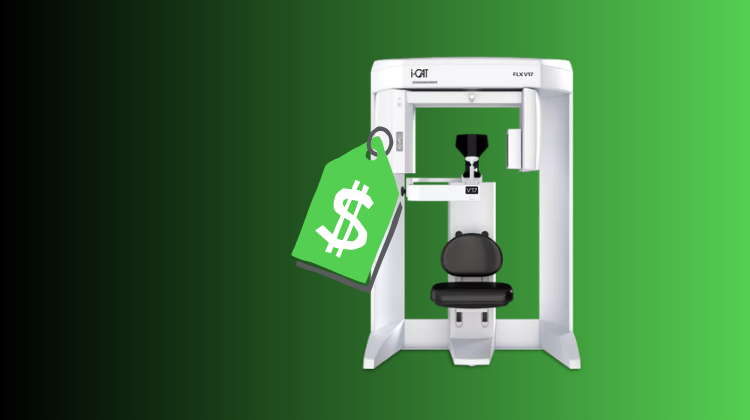
If you're considering adding cone beam computed tomography (CBCT) to your dental practice in 2027, one of your first questions is probably a simple one: How much is a dental CBCT machine going to cost?
The less-simple answer is that CBCT prices can vary considerably. Field of view (FOV), imaging capabilities, software, manufacturer, warranty, installation, and whether you purchase new or Certified Pre-Owned (CPO) equipment can all affect the final price.
As practices begin budgeting for 2027, we expect another factor to become increasingly important: the technology surrounding the CBCT itself. AI-assisted imaging, digital treatment planning, cloud connectivity, and increasingly integrated dental workflows are adding capabilities to today's imaging systems—but they can also affect the total cost of ownership.
Based on 2026 market pricing and current industry trends, here's what dental practices should expect when budgeting for a CBCT machine in 2027.
How Much Does a Dental CBCT Machine Cost Today?
Before predicting 2027 prices, it helps to establish where the market stands in 2026.
Current industry estimates generally put new dental CBCT systems at approximately $50,000 to $150,000, although certain entry-level systems may fall below that range and premium configurations can exceed it. Pricing varies significantly based on FOV, resolution, software, cephalometric capabilities, and other features.
A useful 2026 benchmark looks something like this:
| CBCT Category | Approximate 2026 Price Range |
|---|---|
| Entry-Level / Small FOV | $30,000–$60,000 |
| Mid-Range / Medium FOV | $60,000–$100,000 |
| Large FOV / Full-Featured | $100,000–$150,000+ |
| Certified Pre-Owned |
Often $30-50% less than new list prices (depending on system) |
Important: These are Renew Digital planning estimates, not manufacturer-announced 2027 prices. Actual pricing will depend on the manufacturer, model, configuration, promotions, installation requirements, and market conditions at the time of purchase.
So what happens in 2027?
Dental CBCT Prices: What to Expect in 2027
We don't expect dental practices to wake up on January 1, 2027 and suddenly find that CBCT machines cost dramatically more.
Instead, our expectation is that the overall CBCT market will remain relatively competitive while the price gap between basic imaging systems and premium digital imaging platforms continues to widen.
Rather than expecting uniform price increases across the industry, we think buyers are more likely to see a broader range of choices at different price points.
Will CBCT Prices Go Up or Down in 2027?
Probably a little of both.
The global dental CBCT market continues to expand. Market research published in 2026 estimates the worldwide dental CBCT market will grow from approximately $752 million in 2026 to $1.2 billion by 2033, driven in part by increasing adoption of digital dentistry and demand for implant, orthodontic, endodontic, and surgical applications.
That growth creates competing forces.
On one side, more manufacturers and greater adoption can create competition that helps keep entry-level and mid-range equipment pricing in check.
On the other, manufacturers continue adding increasingly sophisticated capabilities. AI-assisted imaging, advanced reconstruction, larger FOVs, higher-resolution imaging, integrated treatment planning, and expanded software ecosystems can push premium configurations higher.
As a result, we don't necessarily predict that the average CBCT itself will become dramatically more expensive in 2027. Instead, practices may have more choices between affordable systems that handle core 3D imaging needs and premium systems designed to serve as comprehensive digital imaging platforms.
Why AI Could Change What You're Actually Paying For
One of the biggest changes in dental imaging isn't necessarily happening inside the X-ray generator. It's happening in the software.
Artificial intelligence is increasingly being incorporated into dental imaging workflows. Depending on the platform, software may assist with tasks such as anatomical identification, image enhancement, segmentation, treatment planning, and workflow automation.
That creates an important distinction when budgeting for 2027:
The price of the machine and the cost of the imaging ecosystem may increasingly be two different things.
A CBCT with an attractive purchase price may carry recurring software or cloud costs. Another system may have a higher upfront price but include more of the software functionality a practice needs.
When comparing systems, ask:
- What software is included?
- Are there annual licensing fees?
- Are AI features included or subscription-based?
- Are software upgrades included?
- Is implant-planning software included?
- How many workstations or users are licensed?
- Is cloud storage required?
- Can the software integrate with the practice's existing digital workflow?
Those questions could become just as important as the initial equipment price.
2027 New vs. Certified Pre-Owned CBCT Pricing
This is where the buying decision gets particularly interesting.
A practice budgeting $50,000 may have two very different choices: purchase a newer entry-level system or look for a Certified Pre-Owned CBCT that originally occupied a much higher equipment tier.
That distinction matters.
Certified Pre-Owned systems can provide access to larger FOVs, established imaging platforms, and premium manufacturers at prices that may be substantially below comparable new equipment.
For example, a practice may be able to consider CPO systems from established manufacturers such as DEXIS, Carestream, Vatech, Planmeca, i-CAT, Sirona, and others rather than limiting the search exclusively to new entry-level equipment.
Of course, not all used dental equipment is equal.
That's why buyers should look beyond the purchase price and consider refurbishment, inspection, warranty, installation, training, service availability, and long-term support.
At Renew Digital, Certified Pre-Owned means something very different from simply buying a used machine.
What Will Affect CBCT Prices in 2027?
Several factors are likely to determine what your practice actually pays.
1. Field of View
FOV remains one of the biggest factors affecting CBCT pricing.
A small-FOV unit intended primarily for localized endodontic or implant imaging generally costs less than a system capable of capturing both arches, the TMJs, airway, or a larger craniofacial region.
For practices offering multiple services, paying more for a versatile FOV can sometimes make more sense than purchasing solely around today's most common procedure.
2. Panoramic and Cephalometric Imaging
Many CBCT systems also provide traditional panoramic imaging, while certain configurations include or can be upgraded with cephalometric capabilities.
For an orthodontic practice, those capabilities may be essential.
For another practice, they may be unnecessary.
The goal isn't to buy the CBCT with the most features. It's to buy the system with the right features for your clinical needs.
3. Software and AI
Expect software to account for a larger portion of imaging technology decisions.
When comparing prices, make sure you're comparing the complete package—not simply the hardware.
4. Installation and Office Preparation
A $60,000 CBCT doesn't necessarily represent a $60,000 project.
Depending on the practice, additional costs can include room preparation, electrical work, shielding requirements, installation, computers, network upgrades, training, and software.
Current industry estimates suggest room preparation alone can sometimes add thousands of dollars to a CBCT project.
5. Warranty and Service
CBCT is a major piece of clinical equipment. Downtime matters.
A lower equipment price becomes considerably less attractive if the practice has difficulty finding service or faces a major repair shortly after installation.
When comparing prices, ask exactly what the warranty covers, who provides service, and what happens when something goes wrong.
Don't Forget the Total Cost of Ownership
Purchase price gets most of the attention, but it shouldn't be the only number you consider.
When evaluating a 2027 CBCT purchase, calculate:
Equipment + Installation + Software + Training + IT + Service + Financing = Your Real CBCT Cost
For example, some current imaging software platforms carry recurring licensing costs. Service contracts, computer upgrades, storage, and future repairs can also add to the lifetime cost of the system.
This is one reason an apparently cheaper machine isn't always the least expensive machine to own.
Ask your equipment provider for a clear explanation of what's included before comparing quotes.
Should You Buy a CBCT in 2026 or Wait Until 2027?
If you're already considering a CBCT purchase, this may be the more important question.
Waiting simply because you're hoping equipment will become significantly cheaper in 2027 may not be the best strategy. We don't currently see a reason to expect a dramatic, market-wide decline in CBCT prices.
Instead, ask whether your practice can benefit from the equipment now.
Are you currently referring patients elsewhere for 3D scans?
Are you placing implants?
Are you expanding your endodontic capabilities?
Could 3D imaging improve orthodontic or surgical planning?
Are you losing treatment opportunities because you don't have appropriate imaging?
If the answer to several of those questions is yes, the potential value of having CBCT available for another six or twelve months may matter more than a relatively small future change in equipment price.
On the other hand, if your practice isn't clinically ready to use CBCT or you're planning a remodel, relocation, or major technology upgrade in 2027, waiting may make perfect sense.
Buy according to your practice's timeline—not according to predictions about equipment prices.
What About Year-End 2026 Promotions?
Practices planning a 2027 purchase shouldn't automatically overlook the end of 2026.
Manufacturers and equipment dealers frequently use promotions, financing programs, and inventory incentives to encourage year-end purchases. CPO equipment creates another variable because inventory is constantly changing—a particular model available today may not be available several months from now.
There can also be tax considerations.
For tax years beginning in 2026, the IRS lists a maximum Section 179 deduction of $2.56 million, subject to eligibility, business-income limitations, total equipment purchases, and other rules.
Dental equipment may qualify when applicable requirements are met, but tax treatment varies by practice. Always consult your accountant or tax professional regarding your individual situation.
Financing Could Matter More Than Sticker Price
A practice shouldn't necessarily compare a $70,000 CBCT with a $90,000 CBCT based only on the $20,000 difference.
Financing can change the economics considerably.
Term length, interest rate, down payment, promotional financing, and bundled service can all affect the actual monthly cost.
More importantly, the right question may be:
What does it cost our practice each month to own the CBCT, and what value does having 3D imaging in-house create?
That value may come from imaging revenue, fewer outside referrals, improved treatment planning, increased implant or specialty procedures, or simply greater convenience for patients.
The calculation will be different for every practice.
Our 2027 CBCT Prediction
Our expectation for 2027 is not a dramatic increase or decrease in CBCT pricing.
Instead, we anticipate a market with more segmentation.
Entry-level CBCT systems should continue making 3D imaging accessible to smaller practices. Mid-range systems will compete heavily on FOV, workflow, and software. At the premium end, advanced software, AI capabilities, larger FOVs, and integrated digital workflows could continue pushing fully equipped systems into higher price categories.
Meanwhile, the Certified Pre-Owned market should remain an important alternative for practices that want more imaging capability without paying the price of a comparable new system.
That makes comparison shopping increasingly important.
Planning a 2027 CBCT Purchase?
You don't need to wait until 2027 to start planning.
Renew Digital can help you compare new and Certified Pre-Owned dental imaging equipment based on your specialty, desired field of view, office space, budget, and workflow.
Instead of starting with a specific brand, start with what you need your CBCT to accomplish. From there, you can compare systems from leading manufacturers and determine whether buying new or Certified Pre-Owned provides the better value for your practice.
And because CPO inventory changes regularly, starting the conversation early gives you time to understand the market before you're ready to purchase.
Thinking about adding CBCT in 2027? Talk with a Renew Digital imaging expert and start building your equipment budget today.